
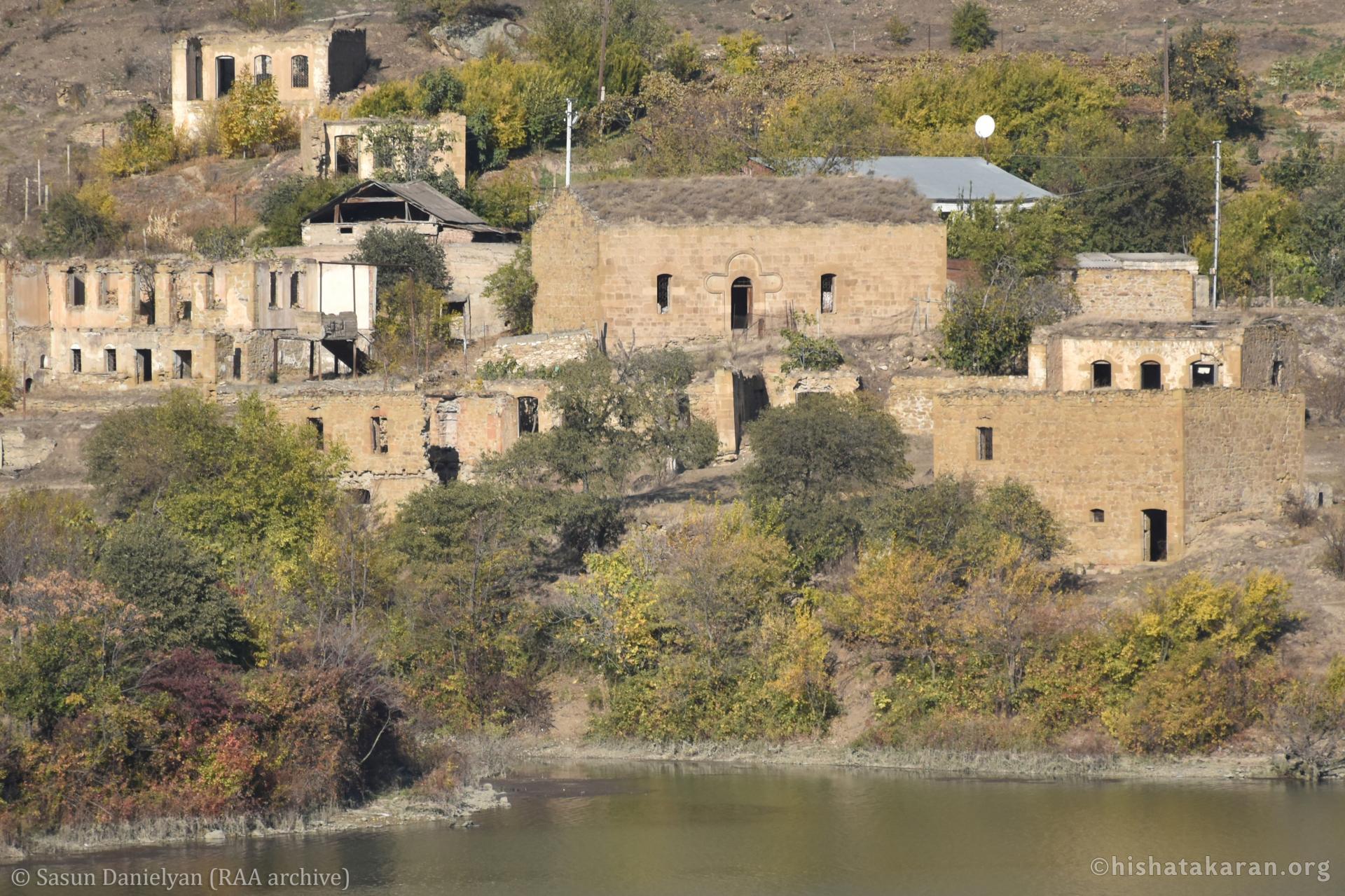
Mataghis, Surb Yeghishe Church
Monument
Monument type
Church Given name
Surb Yeghishe Other names
Surb Yeghisha initial, sequential and current
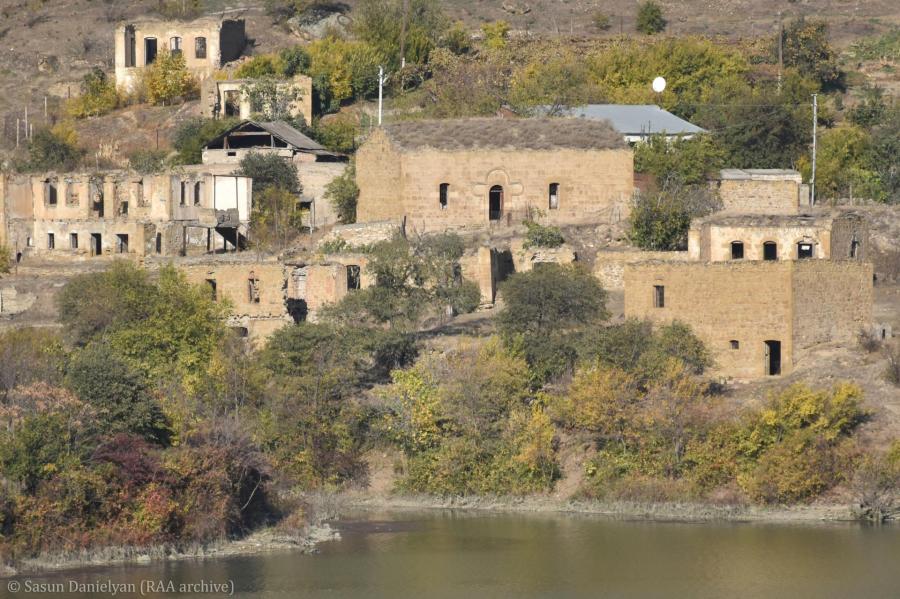
Built in 1898, the church functioned until the early 20th century. During the Soviet period, it was used for economic purposes. During the period of independence, the church was cleaned and restored. Since October 2020, the village of Mataghis has been occupied by Azerbaijan. Videos circulating online, showing Azerbaijani servicemen, confirm that the church has been subjected to vandalism. Fake religious ceremonies have been conducted there by pseudo “clergymen” and “pilgrims.”There is no current information available regarding the condition of the monument.
Original ownership and affiliation
Mataghis The name of conservation unit
Church A topographic report
Region (province), community
At various points in history, Mataghis was part of the districts of Mets Kuenk, Mets Arank, and Nerkin Khachen of the Province of Artsakh in Greater Armenia (later the Principality of Jraberd).Until 2023, it belonged to the Republic of Artsakh, Martakert District.
Address
Republic of Artsakh, Martakert District, Mataghis Topography
Republic of Artsakh, Martakert District, Mataghis Distance and location from community
Located in the western part of Mataghis, in the old quarter of the village. Site elevation above sea level
432 meters above sea level. Hydrography
Situated on the left bank of the Trtu (Tartar) River, along the shore of the Mataghis Reservoir. Description
The Church of Surb Yeghishe (Saint Yeghishe) is situated on the southeastern edge of the old quarter of Mataghis village, in the Martakert District. According to the construction inscription, the building was commenced in 1892 and completed in 1898.The ethnographer and folklorist Bishop Makar Barkhudaryants provides one of the earliest written accounts of the settlement and its newly built, yet unconsecrated, church:
“Mataghis village. Founded on the left bank of the Tartar River, a little above the Paravi Bridge. The village lies in a deep gorge, surrounded on almost all sides by high mountains, while the Tartar flows below, murmuring and roaring. The inhabitants are indigenous; the land belongs to the crown, scarce and of limited fertility. The church is newly constructed, half-finished, and not yet consecrated;
length 15.5 m, width 8.5 m. The priest comes from Varnkatagh. 35 households, 90 men, 75 women.”¹
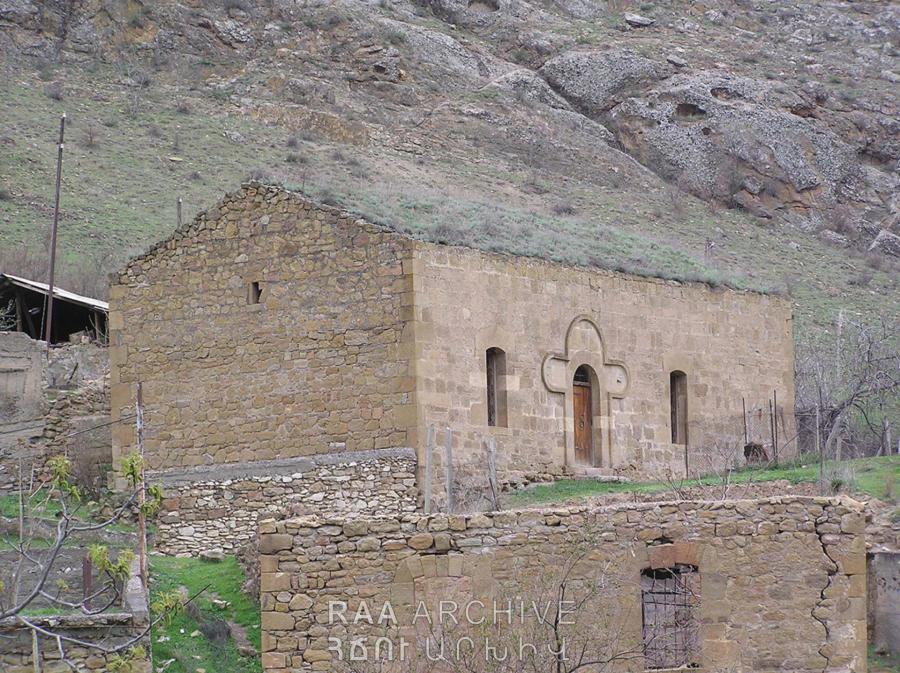
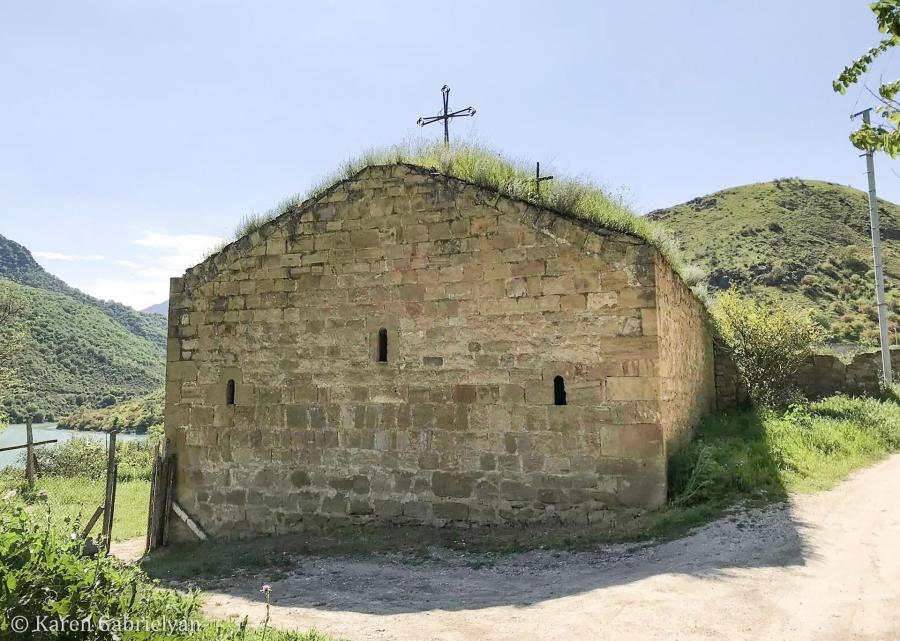
The church is constructed from locally quarried, medium-sized stones, bound with lime mortar and sandstone. The southern façade is faced with yellowish, semi-dressed limestone, while the columns, arches, and architectural openings are executed in finely dressed stone.
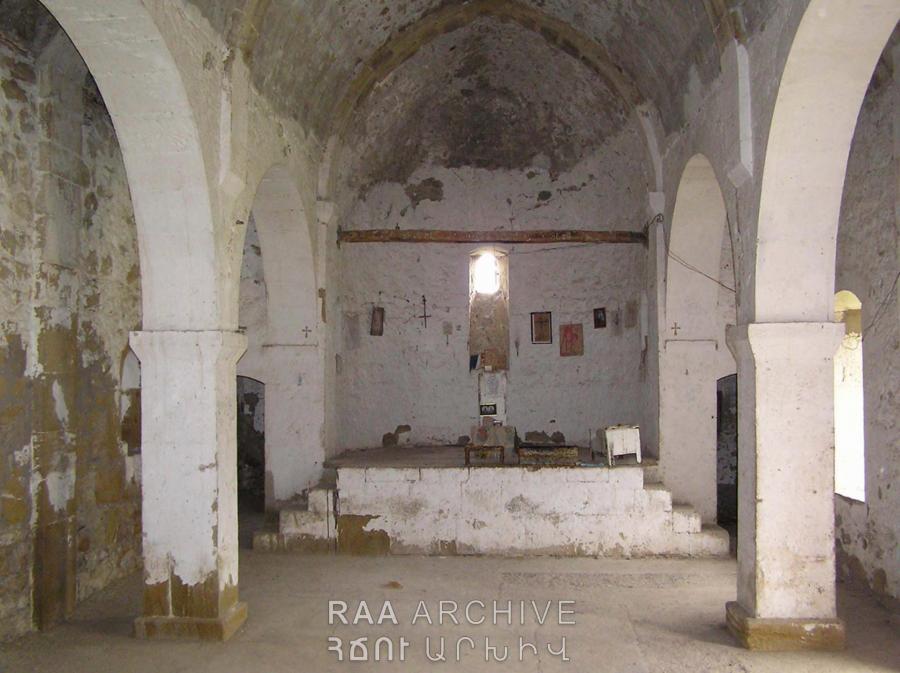
Architecturally, the building follows a rectangular plan, forming a three-nave basilica covered by barrel vaults. Its carefully balanced proportions lend a sense of serene monumentality to the interior space. The vaults of the narrower side naves rest on wall pilasters and on arches springing from four central pillars, while the broader and higher central nave rises above them, its vault supported by these same pillars and by those flanking the apse. This symmetrical and harmonious spatial composition ensures both the structural integrity of the edifice and a bright, spatially open, and visually impressive interior.
At the eastern end lies a semicircular apse, flanked by two sacristies. The wooden rod that once held the altar curtain is still preserved in situ. Small altar niches are set into the apse walls. The bema (altar platform) is elevated and accessed by four steps on either side. Modest cross reliefs are carved on the front of the bema and other sections of the interior.
On the northern wall, near the entrance to the sacristy, stands a baptismal font set within an arched niche. The sole entrance is located on the southern side, marked by an arched doorway framed with a carved cross motif.
Above the doorway, the construction inscription states:
“This Church of Saint Yeghishe was built through the efforts of the community of Mataghis.
Begun in 1892, completed in 1898.”
Above the inscription, at the center, a simple raised cross is carved in relief.
The church is illuminated by six windows—three on the east, two on the south, and one on the west. The eastern and western windows are small, arched, and splayed inward, while the southern windows, positioned on either side of the doorway, are larger. The gabled roof has lost its original stone covering slabs. The interior walls are plastered and whitewashed, preserving the church’s restrained and dignified simplicity.
Historical record
Cultural characteristics, period, century (centuries)
Armenian Apostolic Church, 19th century Documents for dating: Justification of the date based on epigraphy.
According to the construction inscription (1892–1898). Descriptive-Characterization Report
Architectural overview: architectural composition
Rectangular plan, three-nave basilica, vaulted hall. Decorative and monumental features: composition, colours
Building material (type, colour)
Yellowish-white limestone, sandstone, lime mortar. Building openings: entrances (number, orientation)
One entrance, on the south side. Building openings: windows (number, orientation)
Six windows: three on the east, two on the south, one on the west. Structures (load-bearing, roofing)
Arched and barrel-vaulted. Roof (material, type)
Arched and barrel-vaulted. Methods of construction (processing of construction material, masonry, size, type, cladding)
Built of medium-sized stones with lime mortar;all openings, columns, and arches made of dressed limestone;
southern façade faced with finely cut stone.
Finishing and decoration
Simple and restrained. Type
Rural church. Dimensions: length
Length: 15.5 m Dimensions: width
Width: 8.5 m The condition of the monument before the forced displacement of Armenians
Good ----------------------------
1 Barkhudareantsʿ, Makar. 1895. p. 231. Photos
...
Main bibliography
Barkhudareantsʿ, M., 1895 – Barkhudareantsʿ, M., Արցախ [Artsʿakh (Artsakh)]. Bagu, 1895.
.
S. D. , A. L-Y.