
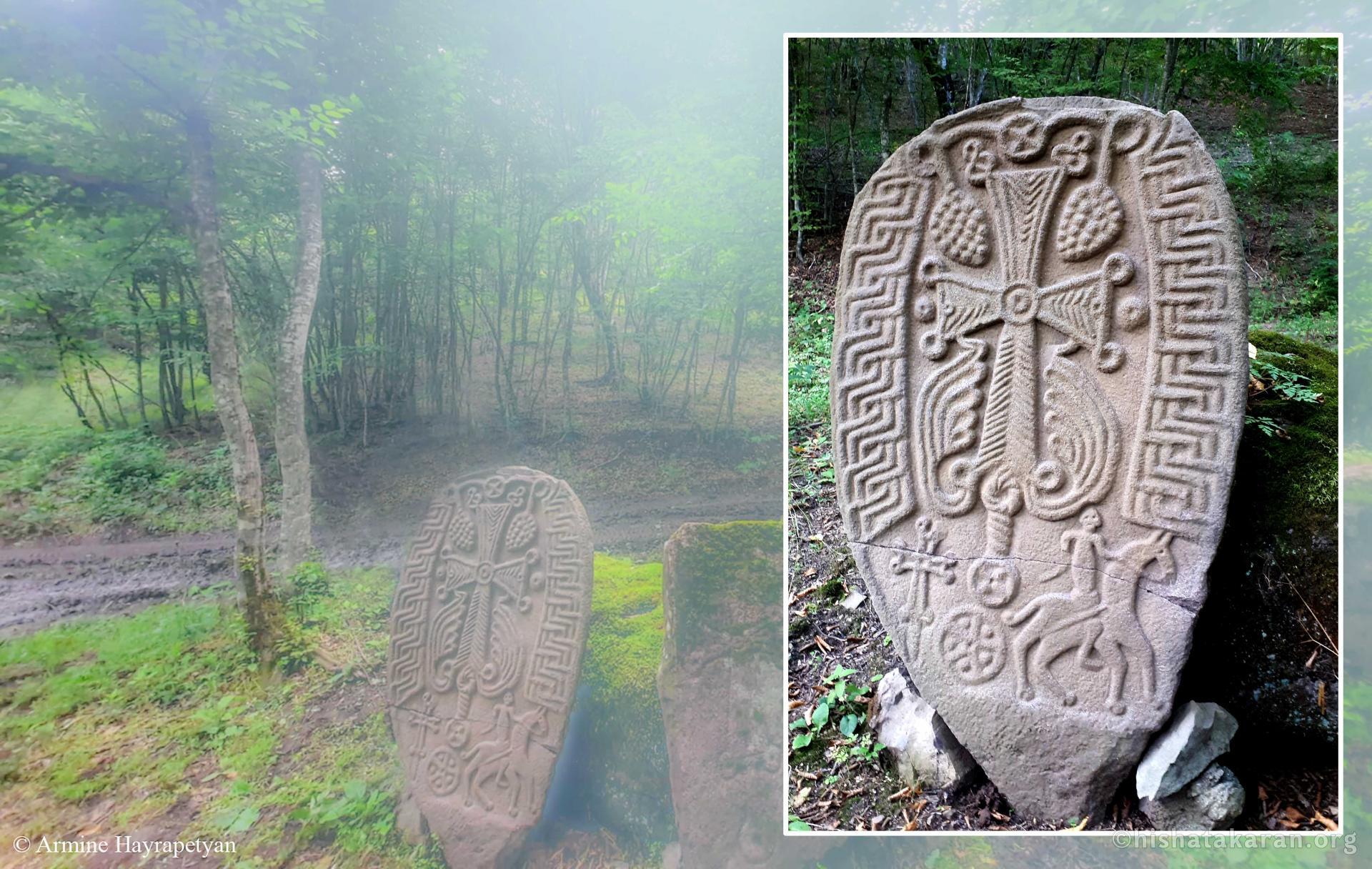
Patara, Darpasut cemetery-shrine, khachkar № 1
Monument
Monument type
Khachkar initial, sequential and current
The khachkar, serving as a tombstone, was carved in the 11th–12th centuries. It was discovered underground and re-erected in 2018. In September 2023, the area was seized by the Azerbaijani army. The current condition of the monument is unknown. Original ownership and affiliation
Settlement of Darpas Vachar (Darpasut) The name of conservation unit
Khachkar A topographic report
Region (province), community
Greater Armenia, Artsakh province, Gardman district (later Khachen), until 2020 – Republic of Artsakh, Askeran region, Patara (Ptretsik). Address
Republic of Artsakh, Askeran region, Patara (Badara) Topography
Located 19.2 km southwest of Askeran. Distance and location from community
Located about 5 km southwest of Patara village, and 1 km southwest of the more recent settlement of Lesnoy. Site elevation above sea level
Approximately 1000 m above sea level. Hydrography
Situated on the left bank of the Patara River. Description
The khachkar is located about 5 km southwest of Patara village in the Askeran region, 568 m northeast of the Darpasut church, in a forested area. It is one of the most remarkable steles of the medieval cemetery — a sculpted khachkar with an arched top, narrowing toward its base. The stone is cracked in its lower section. In 2018, it was unearthed from under a layer of soil, cleaned, and re-erected. In 2019, it was documented and measured by the State Service for the Protection of the Historical Environment of the Ministry of Education, Science, Culture and Sports of the Republic of Artsakh.
The arched-top khachkar is carved from brown sandstone. At its center is the main cross, notable for its unusual iconography: the lower vertical and horizontal arms end in paired circular protrusions, while the upper vertical arm ends in paired trefoils. The entire surface of the cross is covered with diagonal hatch patterns. Notably, the palm branches on either side of the cross stem not from its base, but from the paired circular protrusions of the lower vertical arm. At the base of the cross, the traditional rosette is replaced by a very small circular spiral motif, which continues into a short stem ending in another circular, cross-bearing motif. A similar design appears above the vertical arm of the cross, at the center. To the right and left of this element extend a pair of spiraling vine branches, each bearing a large bunch of grapes that descend toward the center of the cross. Between the paired circular protrusions of the horizontal arms are spherical motifs.
The lower section of the khachkar, on either side of the stem-like cross base, contains carvings of special interest. On the right, moving outward from the center of the khachkar, is a large horseman. According to tradition, the deceased is depicted here, but the relief differs from known parallels. Although the details of the high relief are not numerous, the horse’s bridle is clearly visible, held in the deceased’s left hand, while his right hand appears to whip the animal. Notably, the deceased rides not an ordinary steed, but a cart horse — suggested by a large wheel visible behind, as well as a strap extending from the horse’s neck along its body1.
The horseman’s body is shown in profile from the waist down, but from the waist up — especially the head — is depicted frontally. On the left side of the lower section, the composition is completed by another small cross with a pointed stem. The central composition is framed on both sides by a braided ornamental band.
Historical record
Cultural characteristics, period, century (centuries)
Principality of Khachen, Armenian Apostolic Church, 11th–12th centuries. Documents for dating: Justification of the date based on epigraphy.
Based on stylistic and artistic features. Chronological table of research on the monument (period, author, works)
In his studies on khachkars, cultural historian Hamlet Petrosyan has referred to this monument.
In 2019, the State Service for the Protection of the Historical Environment of the Republic of Artsakh carried out field studies in the area of the monument. The khachkar was measured and recorded.
Descriptive-Characterization Report
Type
Tombstone stele Dimensions: width
90 cm Dimensions: height
180 cm Dimensions: depth, thickness
35 cm The condition of the monument before the forced displacement of Armenians
Average Value
The khachkar, with its decorative and figurative carvings, is highly remarkable. It holds a special place in the khachkar art of Artsakh and is particularly important for the study of the history and cultural heritage of the Askeran region of the Republic of Artsakh, as well as of Patara village. ----------------------------
1 Iconographic analysis by Anna Leyloyan-Yekmalyan. Photos
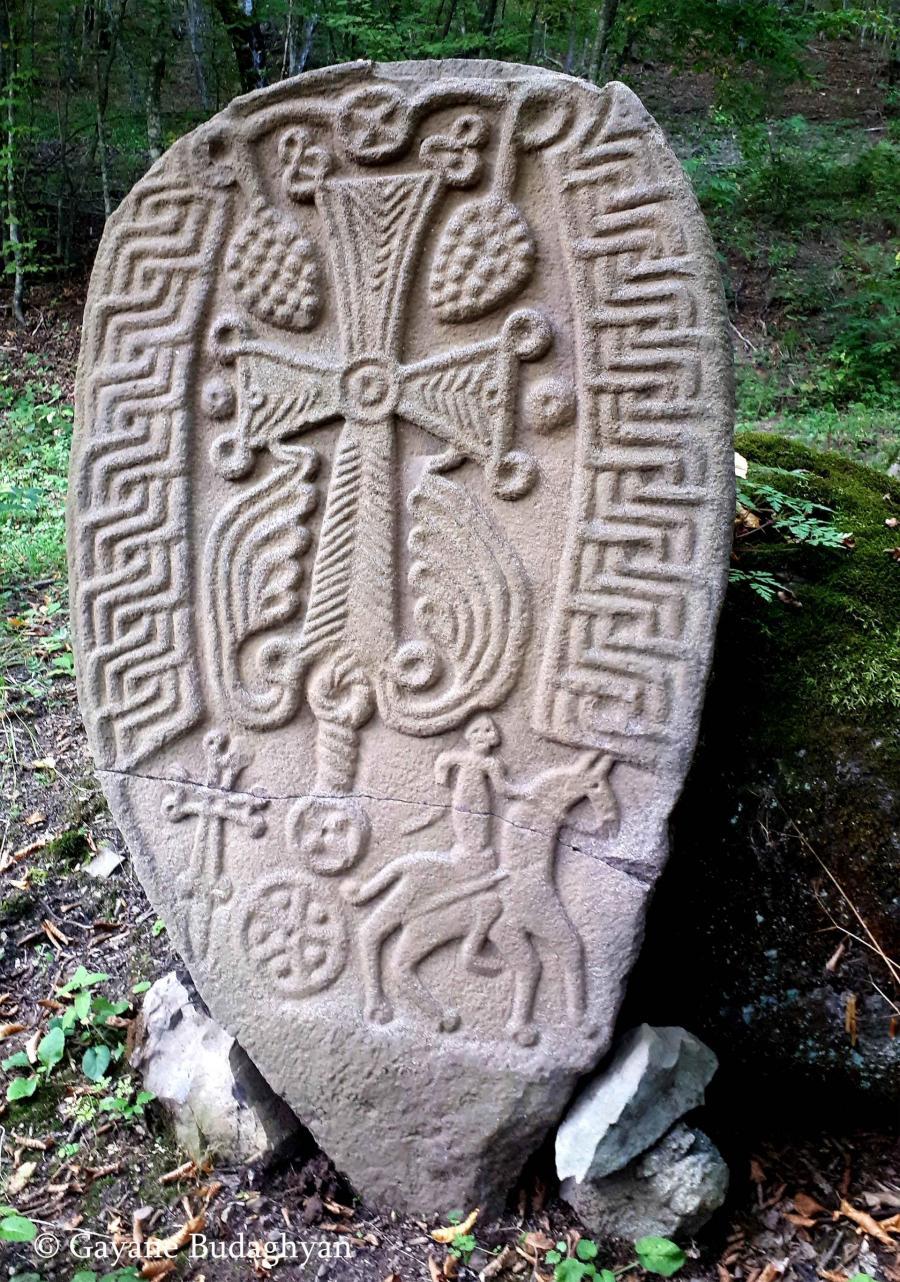
Monument update
On the social network Facebook, according to a video published by the user Fuad Kuliev, we learn that following the ethnic cleansing of Artsakh, khachkar No. 1 of the Darpasut cemetery-sanctuary was toppled, resulting in its breakage along a pre-existing crack. ...
.
A.H., A.L-Y.