
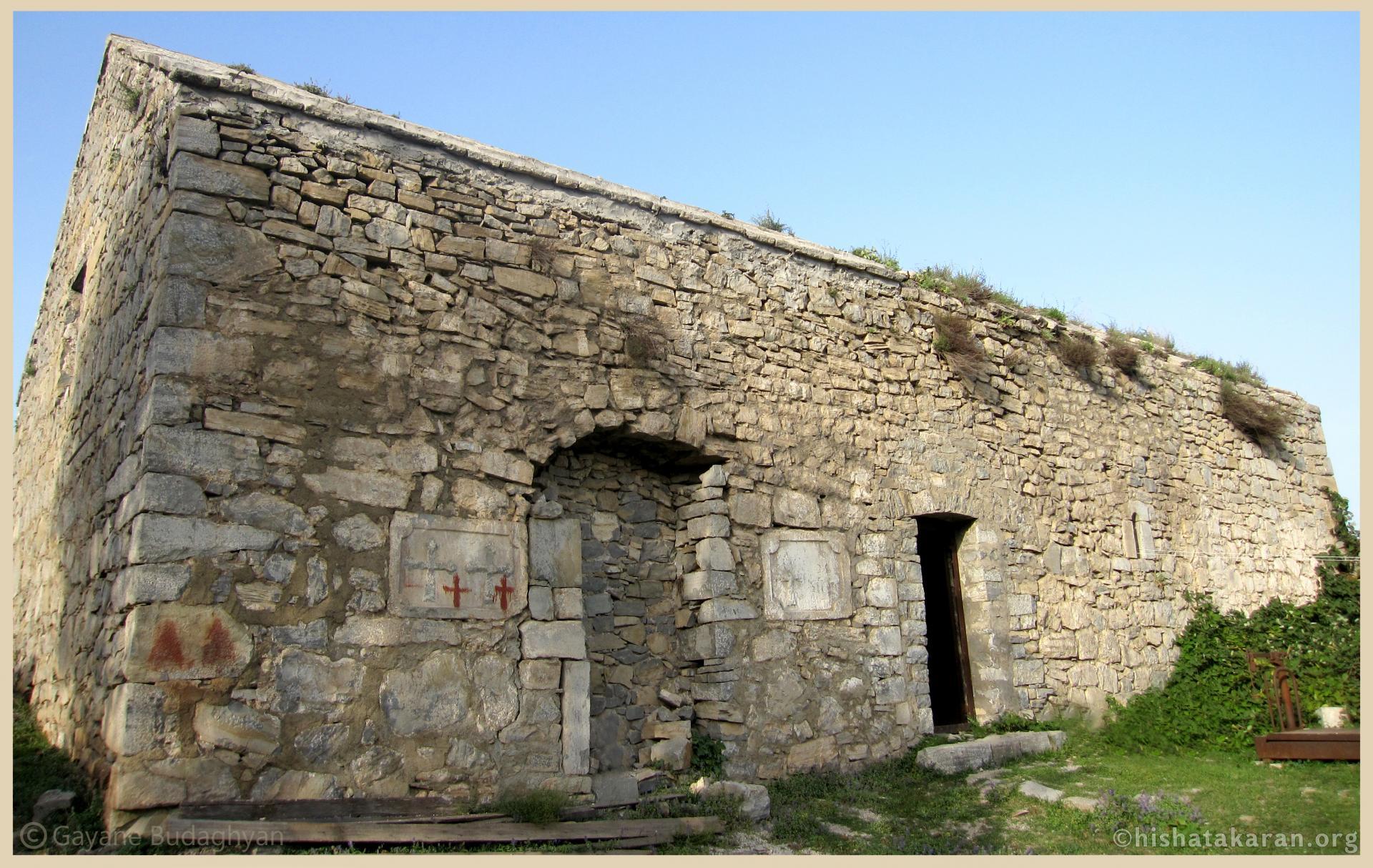
Sarinshen, Surb Astvatsatsin (Holy Mother of God) Church
Monument
Monument type
Curch Given name
Surb Astvatsatsin (Holy Mother of God) initial, sequential and current
It was built in 1867 and functioned until the 1930s. During the Soviet era, it was used for cultural and economic purposes. In the period of independence, the building was partially restored but never functioned as a church again.
The name of conservation unit
Church Individually referenced sections (parts) of conservation unit
A topographic report
Region (province), community
It was part of the historical region of Artsakh in Greater Armenia, specifically the province of Myus Haband (later included in the Dizak province). Until 2020, it was located in the Hadrut region of the Republic of Artsakh.
Distance and location from community
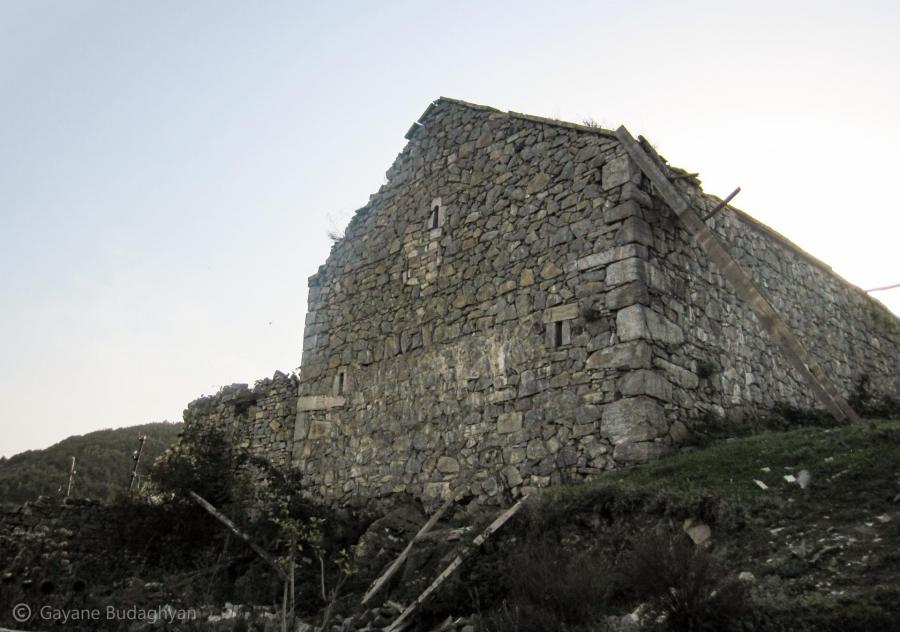
It is located on the northern edge of the village of Sarinshen.
Site elevation above sea level
It is 1,441 meters above sea level. Description
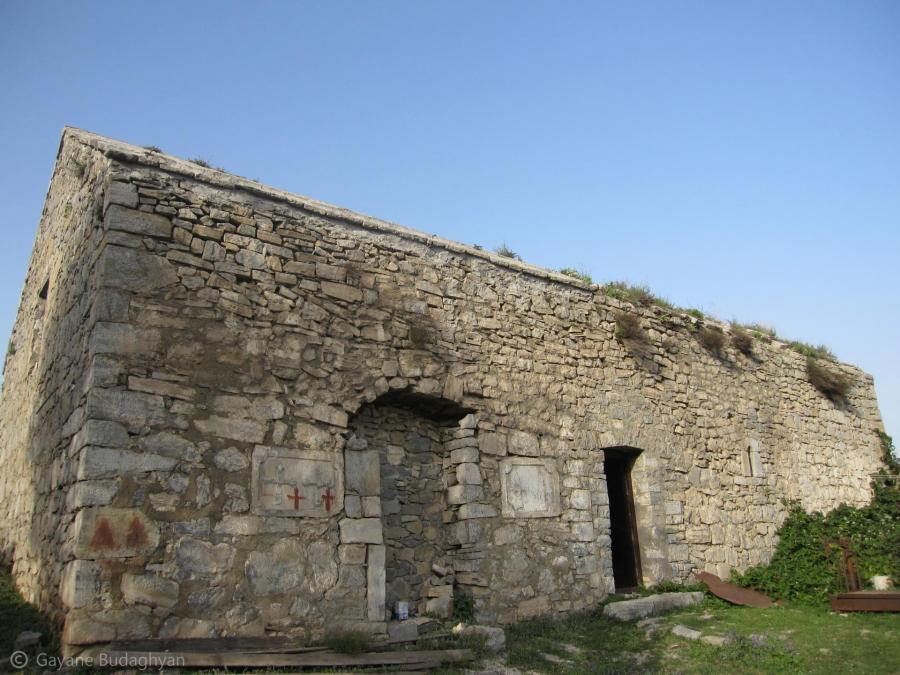
The Church of the Holy Mother of God is located at the northern end of the village of Sarinshen. The inscription regarding the construction of the church is embedded to the right of the entrance to the northern side chamber. Two cross engravings are carved on a rectangular stone, with the inscription in the center reading "…| Ի 1867".
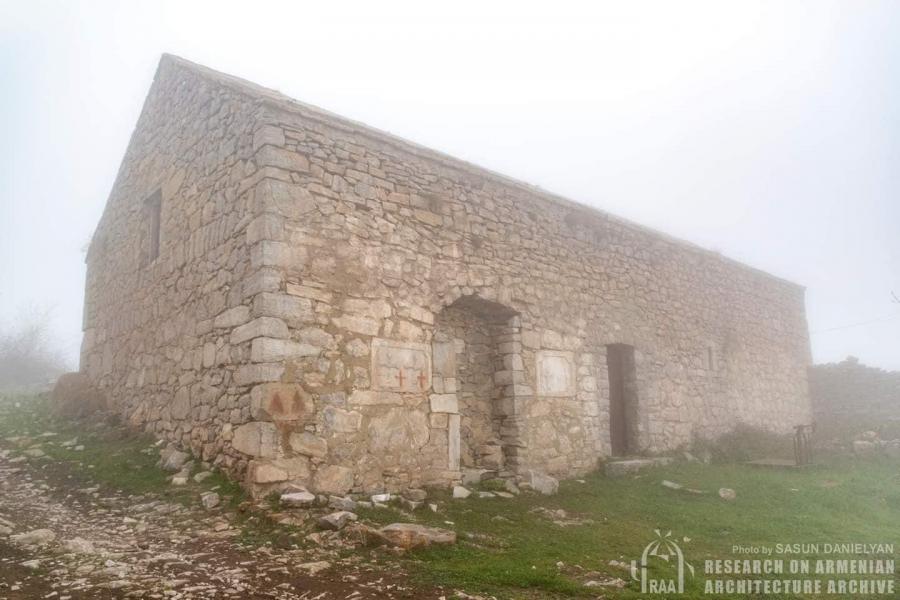
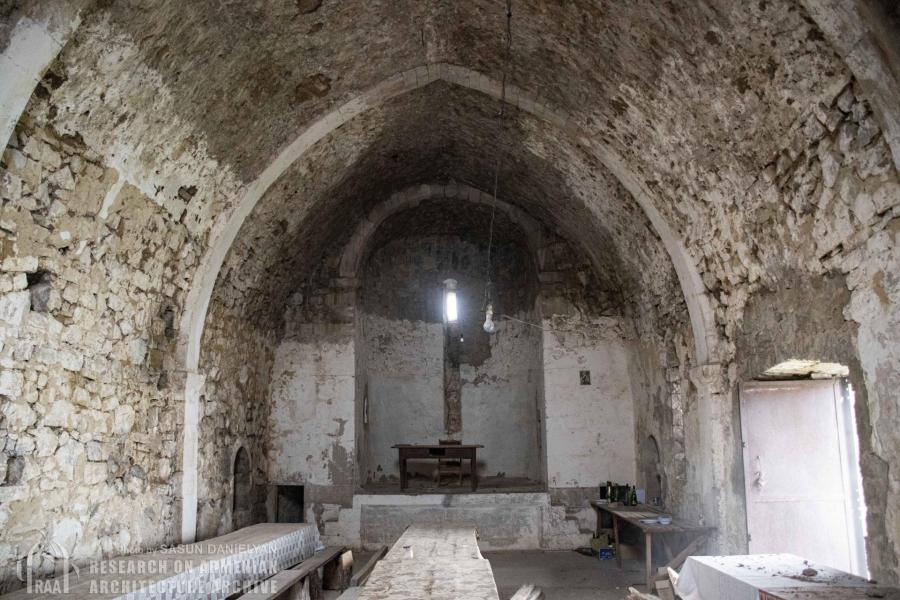
The building is a single-nave hall with a rectangular plan, featuring a semicircular apse on the eastern side and two side chambers. The barrel vault is supported by pointed arches rising from paired wall columns on the northern and southern walls. On either side of the apse, four-step staircases lead up to the stage.
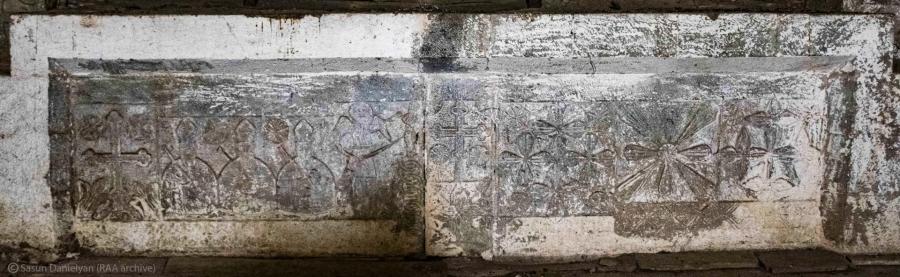
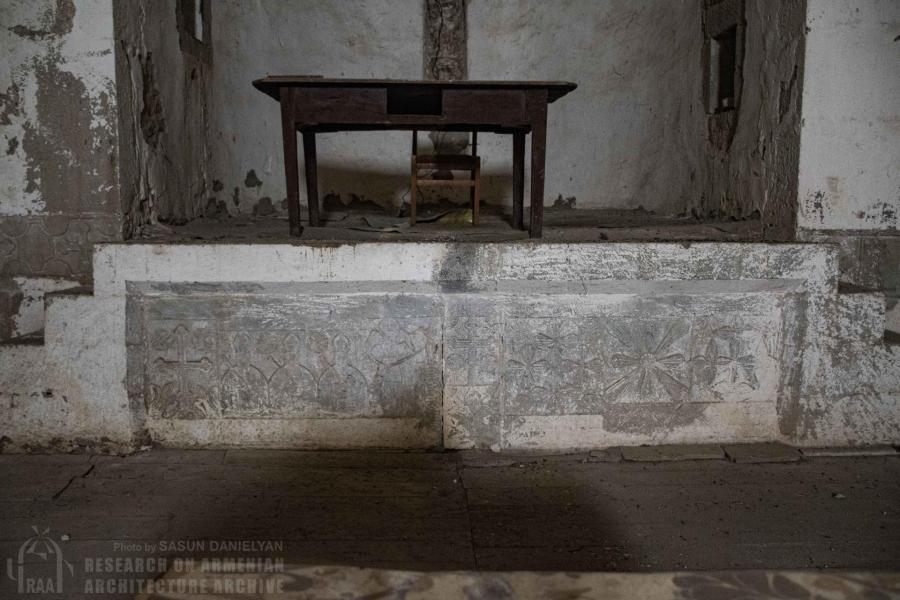
Particularly notable is the decorative sculpture of the altar platform, which is divided into two parts. On the central vertical stone, a cross engraving (above) and a cross-shaped star (below) are carved. The left side of the stage features beautiful cross engravings, with a central cross in bloom, ending in three-lobed arms, and on either side of the upper part are circular cross-shaped rosettes symbolizing the sun and the moon. The lower part features two large and beautiful lilies, symbolizing birth and the renewal of human existence. Next to the cross engravings are the almost similarly represented busts of three biblical patriarchs: Abraham, Isaac, and Jacob. These are usually depicted sitting, receiving the souls of the righteous in the scene of Christ"s Second Coming and the Last Judgment. The iconography of these figures is particularly distinctive, differing significantly from common examples. All three are depicted frontally, without halos, in priestly robes, with their heads covered by pointed caps bearing a cross, and holding scepters. Slightly above them, the Archangel Michael is depicted with a sword in hand, as described in the Book of Daniel, guiding the dead: "Many of those who sleep in the dust of the earth shall awake, some to everlasting life, and some to shame and everlasting contempt".1 To the right of the Archangel Michael, in the upper right corner of the composition, a deceased person is depicted rising from the ground with arms crossed in front. The right side of the stage is divided into four square panels. In the center is a large luminary star, with numerous and varied cross-shaped stars on either side, symbolizing the wise2, who "shall shine like the brightness of the firmament, and those who turn many to righteousness like the stars forever and ever".3
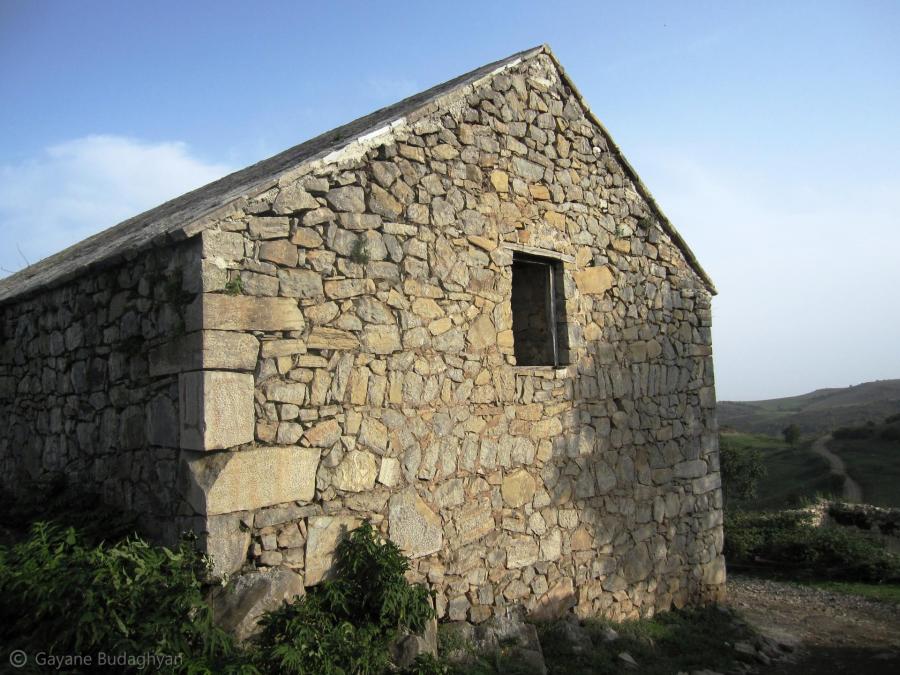
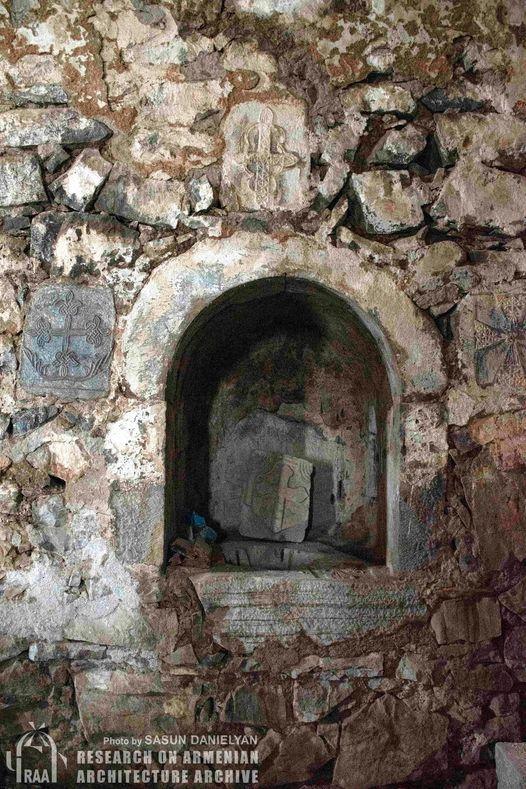
On the side walls of the apse, there are small niches, with the northern one being arched and the southern one rectangular. During the Soviet period, the entrance on the western edge of the southern facade of the church was closed. A new entrance was created in the central part of the same wall. On either side of the old closed entrance, two rectangular stones, finely carved and decorated with crosses, are externally attached. The building is illuminated by one window each on the western and southern facades, and three windows on the eastern facade that widen inward. The two eastern windows are openings from the side chambers. On the northern wall, beneath an arched frame, is the baptismal font, surrounded by three small votive cross carvings. The font, with a cross-shaped interior cavity, is carved from a single piece of stone. Small decorative cross motifs are carved on the right rim of the font. On the southern wall, directly opposite the font, there is another arched niche, with simple representations of two downward-swooping birds carved into the upper part of the arch. Inside the niche, on the back and side walls, are cross carvings. Other small votive cross carvings are attached to the church"s walls. The area also contains fragments of earlier period cross-stones.
During the Soviet era, the church was used as a cultural club and for various economic purposes. Since the 1990s, the church has served as a community events hall. In 2012, the exterior walls of the church were partially restored, and the roof was tiled.
Historical record
Cultural characteristics, period, century (centuries)
Armenian Apostolic Church, 19th century (1867)
Documents for dating: Justification of the date based on epigraphy.
The inscription regarding the church"s construction is attached to the western facade of the side chamber, to the right of the entrance.
Chronological table of monument
Built in 1867. Since the 1930s, the church has been used for economic purposes. From the 1990s, it served as a community hall. In 2012, the exterior walls of the structure were partially renovated, and the roof was tiled. Since October 2020, the village of Sarinshen has been occupied by Azerbaijan. There is no information available about the current condition of the monument.
Brief historical overview
In 1895, the Church of Surb Astvatsatsin (Holy Mother of God) in Sarinshen is mentioned in the work "Artsakh" by Bishop Makar Barkhudaryants. The author notes that the priest used to come from Tsamdzor for the services.
Descriptive-Characterization Report
Architectural overview: architectural composition
The church is a single-nave hall with a barrel vault, featuring a semicircular apse on the eastern side and two side chambers.
Building material (type, colour)
Schist, flint stone, limestone, lime mortal
Building openings: entrances (number, orientation)
It has a single entrance on the southern side.
Building openings: windows (number, orientation)
There are six windows, one opening on the western side, one on the southern side, and three on the eastern facade.
Structures (load-bearing, roofing)
Barrel-vaulted, with a vaulted ceiling
Roof (material, type)
The church"s roof is gabled. It was originally covered with tiles. During the Soviet era, it was covered with asbestos sheets. In 2012, the roof was tiled.
Methods of construction (processing of construction material, masonry, size, type, cladding)
It was constructed using locally sourced rough and unprocessed flint stone, Schist, limestone, and lime mortar. The edging stones of the openings, the altar platform, the pilasters, and the wall arches are finely dressed.
Finishing and decoration
The altar platform is adorned with remarkable reliefs. On the church walls, and especially on the sides of the baptismal font, older cross-stones from an earlier period are embedded.
Type
Village church Dimensions: length
15 m Dimensions: width
6,3 m Dimensions: height
7 m The condition of the monument before the forced displacement of Armenians
Good Value
It holds significant importance for the study of Sarinshen village"s historical past. ----------------------------
1Daniel 13.22The iconographic analysis by Anna Leyloyan-Yekmalyan
3Daniel 13:3
Photos
...
Main bibliography
Mkrtchʻyan Sh․, 1895 - Mkrtchʻyan Shahen, Leṙnayin Gharabaghi patma-chʻartarapetakan hushardzannerě (The historical and architectural monuments of Nagorno-Karabakh), Erevan, 1985.
.
G. B., A. L-Y., S. D.